As eCommerce boomed, printed catalogues began to look like a format from another era. But brands are starting to rethink their role.
Our retail mail customers, including Harrods, have long felt the benefits of using print to engage their audiences.
And amongst other retail beasts, Amazon, Walmart, and J.Crew are just some of the stores that are using catalogues again.
These brands are not doing this for pure nostalgia. Amazon's Holiday Kids Book is now in its ninth year, introducing a new audience to the power of print.
They aren't alone. A growing number of brands are using catalogue marketing to engage with people who have become fatigued by online ads, preferring to seek a more authentic connection.
For this and other reasons, the catalogue is coming back. But it’s not stuck in the past.
How is Print Finding a New Role?
Consumers aren't short of marketing messages.
Email, paid ads, social media, display ads, and app notifications are all trying to get our attention. This makes it tough for each message to stand out.
Research commissioned by Marketreach and analysed by Retail Week found that 60% of consumers felt they received too many marketing messages by email. Only 42% said the same about marketing communications through the post.
A catalogue offers something different. It can be picked up, browsed at the customer's own pace and returned to later.
And consumers appear receptive to that experience. A sizeable 53% say browsing a printed catalogue is more enjoyable than looking at a screen. Meanwhile, 68% are more likely to notice something in a catalogue sent through the post than in a marketing email.
In a marketing world focused on clicks and quick attention, print has a special advantage.
What are Catalogue Mail’s Super Touchpoint Strengths?
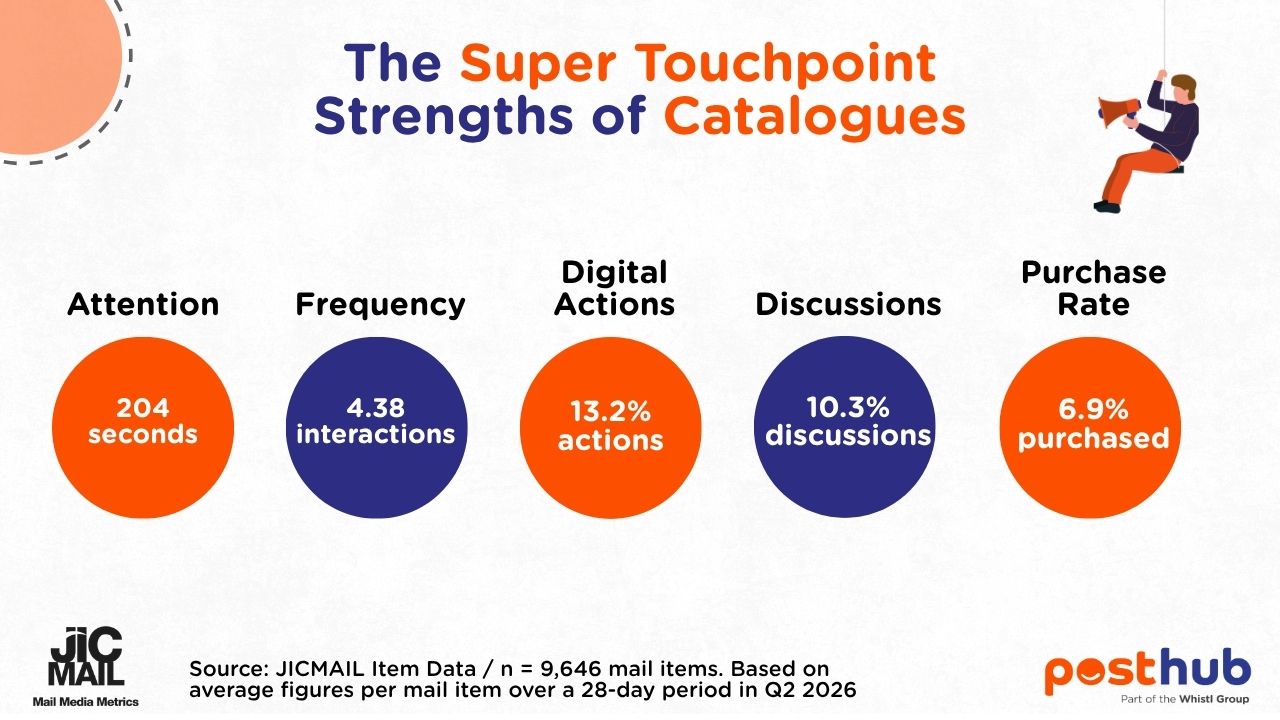
As coined by JICMAIL (Joint Industry Currency for Mail), mail is a Super Touchpoint. This is because “the mail channel has Super Touchpoint planning strengths as a platform for attracting consumer attention, deepening customer relationships and igniting household conversations.”
Printed catalogues are part of this mix. The humble catalogue acts as a physical Super Touchpoint, capable of driving engagement and commercial actions.
In fact, of all mail formats, catalogues gain the most attention. On average, each catalogue is looked at for 204 seconds, compared to 151 seconds for warm direct mail and 178 seconds for business mail.
Catalogues also trigger a relatively strong purchase rate (6.9%) whilst over 13% of catalogue mail prompts a digital action, such as a website visit, online search, or account look-up.
How Has the Catalogue Evolved?
Today's catalogue doesn't need to be a printed version of an eCommerce website.
The old "big book" full of many products is being replaced by thinner books. These new editions are made to inspire customers and help them explore more.
Marketreach and Retail Week discovered that 42% of shoppers observed catalogues getting shorter, and 32% believed they were looking more visually attractive.
This changes the function and purpose of the catalogue format.
Instead of showing everything, brands can use it to showcase seasonal collections, hero products, buying inspiration and carefully selected ranges. The complete selection remains online.
This approach complements eCommerce. Online search works brilliantly when customers already know what they want. But a catalogue can introduce them to something they didn't know to search for.
How Do Catalogues Turn Discovery into Sales?
Catalogue marketing builds awareness and brings in customers.
Browsing a catalogue is also a more considered interaction.
Analysis from Retail Week found consumers spent an average of 15 minutes browsing toy or book catalogues, 12 minutes on electrical or health and beauty catalogues and 11 minutes with fashion catalogues.
For brands, that's an opportunity to do more than push an individual product. A catalogue can show collections together, put products into context and give customers inspiration for their next purchase.
How Did Baukjen Put the Comeback to the Test?
Sustainable fashion retailer, Baukjen, offers a good example of how the role of catalogues is changing.
Catalogues had once been central to its marketing. But the retailer stopped using them in 2022 as it shifted investment towards lower-cost digital channels. Over time, however, some loyal customers stopped buying and emails were failing to cut through the noise.
So Baukjen brought its catalogue back.
In October 2024, it sent an A5 catalogue to 60,000 carefully selected existing customers and a further 40,000 to cold prospects and lapsed customers.
Importantly, print wasn't working alone. The catalogue was coordinated with email, social media and the website, with consistent creative and products across each touchpoint.
The results were strong.
Catalogue recipients went on to account for 52% of total gross sales between 22 October and 2 December.
Print didn’t replace digital. It simply acted as a Super Touchpoint to connect different channels.
How Can Catalogue Readers Go from the Doormat to your Website?
From the moment a customer discovers a product in a catalogue, they can go on to scan a QR code, browse the wider range online and purchase several days later.
In this case, the conversion happens online. But the catalogue helped create the interest.
Data from JICMAIL (Joint Industry Currency for Mail) shows how closely print and digital work together. In the second quarter of 2026, 9.5% of mail prompted a website visit, whilst 56% of purchases driven by mail were completed online.
That's why the modern catalogue shouldn't sit separately from the wider customer journey.
QR codes, offer codes and personalised URLs can provide a simple route from page to screen.
They also help brands understand what happens after the catalogue lands.
What are Ways to Make Print More Immersive?
Technology has paved the way for print to become even more tactile and engaging.
QR codes can link individual products directly to eCommerce pages. Personalisation can tailor products or creative to different customers. And augmented reality can even help customers visualise products within their own homes.
But some immersive principles remain untouched.
Strong photography, high-quality paper, thoughtful design and relevant content can turn a catalogue into something customers want to spend time with.
The important thing is to give the recipient a reason to engage.
Why Smarter Targeting is Better Than Sending More Mail
Catalogues are making a comeback but your plan for using them needs to be effective and relevant.
Baukjen, for example, used recency, frequency and segmentation to select existing customers most likely to respond, whilst treating cold and lapsed audiences separately.
Timing matters too. Christmas, gifting occasions, new collections and seasonal changes can all create natural moments when customers are particularly receptive to inspiration.
Your targeting strategy will be crucial but so will having clean data.
Mail data cleansing, including the removal of duplicates and goneaways, will help you ensure fewer irrelevant catalogues get sent and you maximise your marketing budget.
How Can Sustainability Be Part of your Catalogue Mailing Plan?
More considered catalogue marketing also means thinking carefully about environmental impact.
Targeting, paper choice, pagination, format, print volumes, wrapping and recycling should all form part of campaign planning.
Baukjen reduced the size of its returning catalogue and used an A5 paper wrapped format that qualified for Mailmark Economy.
It also used the catalogue to communicate its sustainability credentials, including PEFC certification.
Why Has Catalogue Marketing Been Reborn?
The catalogue’s reinvention is a reaction to changing consumer behaviour. At one stage it seemed like the only direction of travel was digital.
However, the catalogue has adapted to fit a sweet spot that encourages brand discovery whilst also acting as an effective route to the final purchase.
Today's publication is a tool for inspiration rather than a comprehensive listing. It can introduce products rather than reproduce an entire range. And instead of competing with digital, it bridges the gap between the offline and online worlds.
This creates a great opportunity.
Digital offers convenience, choice and an immediate path to purchase. Print offers something increasingly valuable: time, attention and physical presence.
Bring the two together and the catalogue starts to look much less like a format from retail's past, and much more like a useful part of its future.
Thinking About Your Next Catalogue Campaign?
We’re passionate about post!
If you’re looking to use printed catalogues as part of your campaign mix, our friendly team is ready to support with all aspects of direct mail management.
From data cleansing to mail proofing and handover for final-mile delivery, we take care of the complete postal journey.
Talk to us today about your next catalogue mailing.
Get a Postal Quote
Sending catalogues? Let's have a conversation about competitively priced postage and expert direct mail management.
Share this article
You may also like...